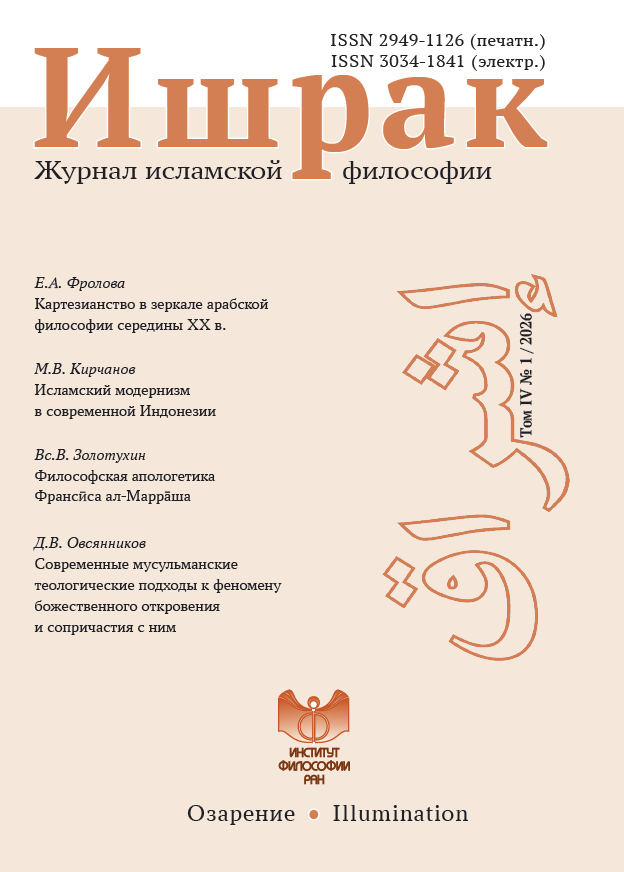
Islamic Modernism in Contemporary Indonesia
(“Muhammadiyah” Ideology of the First Half of the 2020s)
DOI:
https://doi.org/10.21146/2949-1126-2026-4-1-17-35Keywords:
Indonesia, Islam, Intellectual Community, Muslim Intellectuals, Interpretations of Modernity, Modernity and Anti-Modernity, Secularization, Modernism, TraditionalismAbstract
This article aims to analyse perceptions of modernity within contemporary Islamic intellectual traditions in Indonesia. The novelty of this study lies in its comprehensive and comparative analysis of the various visions and perceptions of modernity within contemporary Muslim intellectual discourse in Indonesian society. The principles of intellectual history proposed here allow us to view Muslim intellectuals engaged in the study of modernity-related issues as an imagined community and their ideas as an invented tradition. These principles form the methodological core of the article. The article analyses: the perception of the concept of “modernity” in Indonesian Muslim intellectual texts; attempts by Muslim intellectuals to identify and define the main features of modernity as a historical and cultural state; the directions and features of the transformation and development of the concept of “modernity” in contemporary Muslim thought in Indonesia. The author assumes that Muslim intellectuals make a significant contribution to the modernisation of Indonesian society since analysing the problems of modernity actually legitimises the processes of political and social modernisation and transformation. The authorʼs main conclusions are as follows: 1) The emergence and development of the concept of modernity in Indonesian Muslim intellectual discourse was influenced by external colonial and postcolonial factors; 2) Muslim intellectuals constructed and offered visions and perceptions of modernity, integrating them simultaneously into the transplanted secular discourse of Western science and rational knowledge, and the intellectual traditions of Islam; 3) The concepts of modernity in the intellectual imagination of Indonesian Muslim thinkers are instrumentalised, and their analysis is linked to the general rational premises of the modernisation model of social development.